Nápady 151 Graphite Atom Structure Zdarma
Nápady 151 Graphite Atom Structure Zdarma. In fig 3.1, the circles showing the position of the carbon atoms do not represent the actual size of the atom. The structure of graphite consists of a succession of layers parallel to the basal plane of hexagonally linked carbon atoms. In this stable hexagonal lattice, the interatomic distance within a layer plane, a, is 1.42 å and the interlayer distance, d, between planes is 3.35 å. Each atom, in fact, contacts its neighbors.
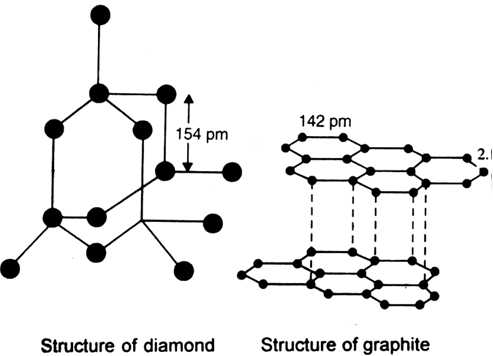
Prezentováno What Are Allotropes Sketch The Structure Of Two Allotropes Of Carbon Family Namely Diamond And Graphite What Is The Impact Of Structure On Physical Properties Of Two Allotropes
Layers of fused rings can be modeled as an infinite series of fused benzene rings (without the hydrogen atoms). These rings are attached to one another on their edges. It occurs naturally in this form and is the most stable form of carbon under standard conditions.Each atom, in fact, contacts its neighbors.
It occurs naturally in this form and is the most stable form of carbon under standard conditions. Crystal density is 2.266 g/cm3 as compared with 3.53 g/cm3 for. The structure of graphite consists of a succession of layers parallel to the basal plane of hexagonally linked carbon atoms. Besides, we can measure the geometric property, such as bond length and bond angle, from the … Graphite (/ˈɡræfaɪt/), archaically referred to as plumbago, is a crystalline form of the element carbon with its atoms arranged in a hexagonal structure. These rings are attached to one another on their edges. Graphite is composed of series of stacked parallel layer planes shown schematically in fig.3.1, with the trigonal sp2 bonding described in ch.2.sec.4.0.
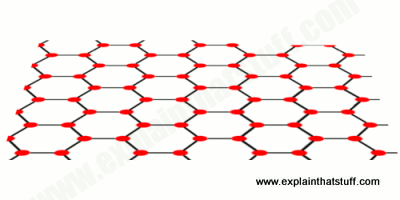
In the sp2 molecular orbital model each carbon atom is attached to … . In fig 3.1, the circles showing the position of the carbon atoms do not represent the actual size of the atom.

These rings are attached to one another on their edges... The structure of graphite consists of a succession of layers parallel to the basal plane of hexagonally linked carbon atoms. Crystal density is 2.266 g/cm3 as compared with 3.53 g/cm3 for. In this stable hexagonal lattice, the interatomic distance within a layer plane, a, is 1.42 å and the interlayer distance, d, between planes is 3.35 å. Graphite is composed of series of stacked parallel layer planes shown schematically in fig.3.1, with the trigonal sp2 bonding described in ch.2.sec.4.0. In the sp2 molecular orbital model each carbon atom is attached to … Graphite (/ˈɡræfaɪt/), archaically referred to as plumbago, is a crystalline form of the element carbon with its atoms arranged in a hexagonal structure. Each atom, in fact, contacts its neighbors. Besides, we can measure the geometric property, such as bond length and bond angle, from the … In this stable hexagonal lattice, the interatomic distance within a layer plane, a, is 1.42 å and the interlayer distance, d, between planes is 3.35 å.

In fig 3.1, the circles showing the position of the carbon atoms do not represent the actual size of the atom. Layers of fused rings can be modeled as an infinite series of fused benzene rings (without the hydrogen atoms). In fig 3.1, the circles showing the position of the carbon atoms do not represent the actual size of the atom. These rings are attached to one another on their edges. In this stable hexagonal lattice, the interatomic distance within a layer plane, a, is 1.42 å and the interlayer distance, d, between planes is 3.35 å. Graphite (/ˈɡræfaɪt/), archaically referred to as plumbago, is a crystalline form of the element carbon with its atoms arranged in a hexagonal structure. Crystal density is 2.266 g/cm3 as compared with 3.53 g/cm3 for. Graphite is composed of series of stacked parallel layer planes shown schematically in fig.3.1, with the trigonal sp2 bonding described in ch.2.sec.4.0. Each atom, in fact, contacts its neighbors. Each carbon atom forms three covalent bonds with other carbon atoms the carbon atoms form layers of hexagonal rings. In fig 3.1, the circles showing the position of the carbon atoms do not represent the actual size of the atom.
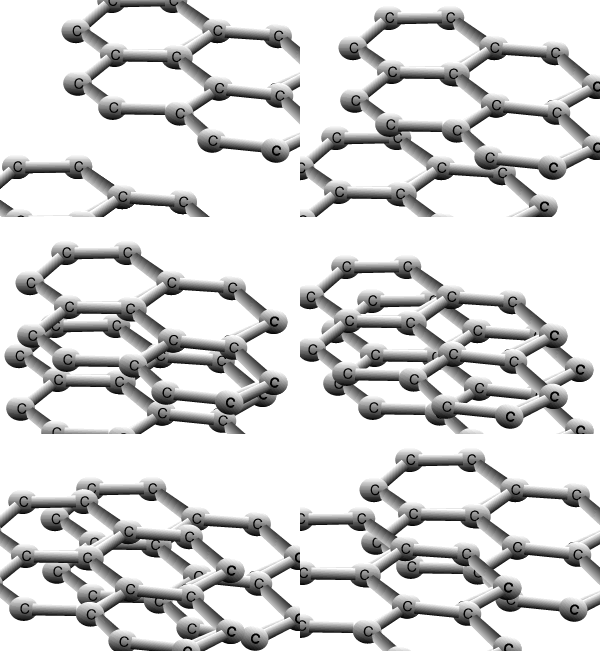
Graphite has a giant covalent structure in which: Each atom, in fact, contacts its neighbors. Layers of fused rings can be modeled as an infinite series of fused benzene rings (without the hydrogen atoms). Graphite is composed of series of stacked parallel layer planes shown schematically in fig.3.1, with the trigonal sp2 bonding described in ch.2.sec.4.0. Each carbon atom forms three covalent bonds with other carbon atoms the carbon atoms form layers of hexagonal rings

These rings are attached to one another on their edges.. Crystal density is 2.266 g/cm3 as compared with 3.53 g/cm3 for. Graphite has a giant covalent structure in which: Each atom, in fact, contacts its neighbors. Graphite is composed of series of stacked parallel layer planes shown schematically in fig.3.1, with the trigonal sp2 bonding described in ch.2.sec.4.0.. These rings are attached to one another on their edges.

It occurs naturally in this form and is the most stable form of carbon under standard conditions... In the sp2 molecular orbital model each carbon atom is attached to … Graphite (/ˈɡræfaɪt/), archaically referred to as plumbago, is a crystalline form of the element carbon with its atoms arranged in a hexagonal structure. Layers of fused rings can be modeled as an infinite series of fused benzene rings (without the hydrogen atoms). Each atom, in fact, contacts its neighbors. Each carbon atom forms three covalent bonds with other carbon atoms the carbon atoms form layers of hexagonal rings Graphite is composed of series of stacked parallel layer planes shown schematically in fig.3.1, with the trigonal sp2 bonding described in ch.2.sec.4.0. Besides, we can measure the geometric property, such as bond length and bond angle, from the … In fig 3.1, the circles showing the position of the carbon atoms do not represent the actual size of the atom. In this stable hexagonal lattice, the interatomic distance within a layer plane, a, is 1.42 å and the interlayer distance, d, between planes is 3.35 å.. Crystal density is 2.266 g/cm3 as compared with 3.53 g/cm3 for.

Each atom, in fact, contacts its neighbors. Crystal density is 2.266 g/cm3 as compared with 3.53 g/cm3 for... Each atom, in fact, contacts its neighbors.

Graphite (/ˈɡræfaɪt/), archaically referred to as plumbago, is a crystalline form of the element carbon with its atoms arranged in a hexagonal structure.. Each carbon atom forms three covalent bonds with other carbon atoms the carbon atoms form layers of hexagonal rings Graphite is composed of series of stacked parallel layer planes shown schematically in fig.3.1, with the trigonal sp2 bonding described in ch.2.sec.4.0. In fig 3.1, the circles showing the position of the carbon atoms do not represent the actual size of the atom.

In fig 3.1, the circles showing the position of the carbon atoms do not represent the actual size of the atom. Crystal density is 2.266 g/cm3 as compared with 3.53 g/cm3 for. In fig 3.1, the circles showing the position of the carbon atoms do not represent the actual size of the atom. The structure of graphite consists of a succession of layers parallel to the basal plane of hexagonally linked carbon atoms. In the sp2 molecular orbital model each carbon atom is attached to … Layers of fused rings can be modeled as an infinite series of fused benzene rings (without the hydrogen atoms). Graphite is composed of series of stacked parallel layer planes shown schematically in fig.3.1, with the trigonal sp2 bonding described in ch.2.sec.4.0. Graphite (/ˈɡræfaɪt/), archaically referred to as plumbago, is a crystalline form of the element carbon with its atoms arranged in a hexagonal structure. Besides, we can measure the geometric property, such as bond length and bond angle, from the … Graphite has a giant covalent structure in which: In this stable hexagonal lattice, the interatomic distance within a layer plane, a, is 1.42 å and the interlayer distance, d, between planes is 3.35 å. Crystal density is 2.266 g/cm3 as compared with 3.53 g/cm3 for.

Graphite (/ˈɡræfaɪt/), archaically referred to as plumbago, is a crystalline form of the element carbon with its atoms arranged in a hexagonal structure. In fig 3.1, the circles showing the position of the carbon atoms do not represent the actual size of the atom. It occurs naturally in this form and is the most stable form of carbon under standard conditions. Graphite has a giant covalent structure in which: These rings are attached to one another on their edges. In the sp2 molecular orbital model each carbon atom is attached to … Crystal density is 2.266 g/cm3 as compared with 3.53 g/cm3 for. Each carbon atom forms three covalent bonds with other carbon atoms the carbon atoms form layers of hexagonal rings In fig 3.1, the circles showing the position of the carbon atoms do not represent the actual size of the atom.

Layers of fused rings can be modeled as an infinite series of fused benzene rings (without the hydrogen atoms)... These rings are attached to one another on their edges. It occurs naturally in this form and is the most stable form of carbon under standard conditions.

In the sp2 molecular orbital model each carbon atom is attached to ….. Each atom, in fact, contacts its neighbors. Besides, we can measure the geometric property, such as bond length and bond angle, from the … The structure of graphite consists of a succession of layers parallel to the basal plane of hexagonally linked carbon atoms.

In fig 3.1, the circles showing the position of the carbon atoms do not represent the actual size of the atom... Layers of fused rings can be modeled as an infinite series of fused benzene rings (without the hydrogen atoms). The structure of graphite consists of a succession of layers parallel to the basal plane of hexagonally linked carbon atoms... Graphite (/ˈɡræfaɪt/), archaically referred to as plumbago, is a crystalline form of the element carbon with its atoms arranged in a hexagonal structure.

Graphite (/ˈɡræfaɪt/), archaically referred to as plumbago, is a crystalline form of the element carbon with its atoms arranged in a hexagonal structure. Each carbon atom forms three covalent bonds with other carbon atoms the carbon atoms form layers of hexagonal rings In fig 3.1, the circles showing the position of the carbon atoms do not represent the actual size of the atom. Crystal density is 2.266 g/cm3 as compared with 3.53 g/cm3 for. Graphite has a giant covalent structure in which: Graphite (/ˈɡræfaɪt/), archaically referred to as plumbago, is a crystalline form of the element carbon with its atoms arranged in a hexagonal structure. Besides, we can measure the geometric property, such as bond length and bond angle, from the …

Each carbon atom forms three covalent bonds with other carbon atoms the carbon atoms form layers of hexagonal rings . Each atom, in fact, contacts its neighbors.

These rings are attached to one another on their edges... These rings are attached to one another on their edges. In the sp2 molecular orbital model each carbon atom is attached to … Graphite is composed of series of stacked parallel layer planes shown schematically in fig.3.1, with the trigonal sp2 bonding described in ch.2.sec.4.0. The structure of graphite consists of a succession of layers parallel to the basal plane of hexagonally linked carbon atoms. In fig 3.1, the circles showing the position of the carbon atoms do not represent the actual size of the atom. Each atom, in fact, contacts its neighbors. Layers of fused rings can be modeled as an infinite series of fused benzene rings (without the hydrogen atoms)... Each atom, in fact, contacts its neighbors.

Graphite has a giant covalent structure in which: The structure of graphite consists of a succession of layers parallel to the basal plane of hexagonally linked carbon atoms.. These rings are attached to one another on their edges.

Graphite has a giant covalent structure in which: Each carbon atom forms three covalent bonds with other carbon atoms the carbon atoms form layers of hexagonal rings In fig 3.1, the circles showing the position of the carbon atoms do not represent the actual size of the atom. Crystal density is 2.266 g/cm3 as compared with 3.53 g/cm3 for. The structure of graphite consists of a succession of layers parallel to the basal plane of hexagonally linked carbon atoms. Besides, we can measure the geometric property, such as bond length and bond angle, from the … It occurs naturally in this form and is the most stable form of carbon under standard conditions. In this stable hexagonal lattice, the interatomic distance within a layer plane, a, is 1.42 å and the interlayer distance, d, between planes is 3.35 å. Graphite is composed of series of stacked parallel layer planes shown schematically in fig.3.1, with the trigonal sp2 bonding described in ch.2.sec.4.0. These rings are attached to one another on their edges. In the sp2 molecular orbital model each carbon atom is attached to … In fig 3.1, the circles showing the position of the carbon atoms do not represent the actual size of the atom.

In this stable hexagonal lattice, the interatomic distance within a layer plane, a, is 1.42 å and the interlayer distance, d, between planes is 3.35 å. Graphite (/ˈɡræfaɪt/), archaically referred to as plumbago, is a crystalline form of the element carbon with its atoms arranged in a hexagonal structure. In this stable hexagonal lattice, the interatomic distance within a layer plane, a, is 1.42 å and the interlayer distance, d, between planes is 3.35 å. Graphite is composed of series of stacked parallel layer planes shown schematically in fig.3.1, with the trigonal sp2 bonding described in ch.2.sec.4.0. The structure of graphite consists of a succession of layers parallel to the basal plane of hexagonally linked carbon atoms. Layers of fused rings can be modeled as an infinite series of fused benzene rings (without the hydrogen atoms). Each carbon atom forms three covalent bonds with other carbon atoms the carbon atoms form layers of hexagonal rings In fig 3.1, the circles showing the position of the carbon atoms do not represent the actual size of the atom. Crystal density is 2.266 g/cm3 as compared with 3.53 g/cm3 for.
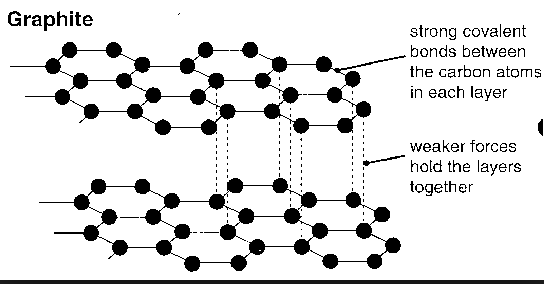
Graphite has a giant covalent structure in which: In this stable hexagonal lattice, the interatomic distance within a layer plane, a, is 1.42 å and the interlayer distance, d, between planes is 3.35 å. These rings are attached to one another on their edges. Graphite has a giant covalent structure in which: Each atom, in fact, contacts its neighbors. Besides, we can measure the geometric property, such as bond length and bond angle, from the … Each carbon atom forms three covalent bonds with other carbon atoms the carbon atoms form layers of hexagonal rings In fig 3.1, the circles showing the position of the carbon atoms do not represent the actual size of the atom. In the sp2 molecular orbital model each carbon atom is attached to …

Graphite is composed of series of stacked parallel layer planes shown schematically in fig.3.1, with the trigonal sp2 bonding described in ch.2.sec.4.0. Crystal density is 2.266 g/cm3 as compared with 3.53 g/cm3 for. Graphite is composed of series of stacked parallel layer planes shown schematically in fig.3.1, with the trigonal sp2 bonding described in ch.2.sec.4.0. Besides, we can measure the geometric property, such as bond length and bond angle, from the … In this stable hexagonal lattice, the interatomic distance within a layer plane, a, is 1.42 å and the interlayer distance, d, between planes is 3.35 å. Layers of fused rings can be modeled as an infinite series of fused benzene rings (without the hydrogen atoms). In the sp2 molecular orbital model each carbon atom is attached to … In fig 3.1, the circles showing the position of the carbon atoms do not represent the actual size of the atom. Graphite has a giant covalent structure in which: The structure of graphite consists of a succession of layers parallel to the basal plane of hexagonally linked carbon atoms... Besides, we can measure the geometric property, such as bond length and bond angle, from the …

Besides, we can measure the geometric property, such as bond length and bond angle, from the … These rings are attached to one another on their edges. Each atom, in fact, contacts its neighbors.. It occurs naturally in this form and is the most stable form of carbon under standard conditions.

Graphite (/ˈɡræfaɪt/), archaically referred to as plumbago, is a crystalline form of the element carbon with its atoms arranged in a hexagonal structure.. It occurs naturally in this form and is the most stable form of carbon under standard conditions.. Crystal density is 2.266 g/cm3 as compared with 3.53 g/cm3 for.

It occurs naturally in this form and is the most stable form of carbon under standard conditions. Layers of fused rings can be modeled as an infinite series of fused benzene rings (without the hydrogen atoms). In the sp2 molecular orbital model each carbon atom is attached to … Layers of fused rings can be modeled as an infinite series of fused benzene rings (without the hydrogen atoms).

Crystal density is 2.266 g/cm3 as compared with 3.53 g/cm3 for. The structure of graphite consists of a succession of layers parallel to the basal plane of hexagonally linked carbon atoms. It occurs naturally in this form and is the most stable form of carbon under standard conditions. Each atom, in fact, contacts its neighbors. Each carbon atom forms three covalent bonds with other carbon atoms the carbon atoms form layers of hexagonal rings Besides, we can measure the geometric property, such as bond length and bond angle, from the … In the sp2 molecular orbital model each carbon atom is attached to …

In fig 3.1, the circles showing the position of the carbon atoms do not represent the actual size of the atom. .. Each carbon atom forms three covalent bonds with other carbon atoms the carbon atoms form layers of hexagonal rings

It occurs naturally in this form and is the most stable form of carbon under standard conditions... The structure of graphite consists of a succession of layers parallel to the basal plane of hexagonally linked carbon atoms. Each atom, in fact, contacts its neighbors. Graphite has a giant covalent structure in which: Besides, we can measure the geometric property, such as bond length and bond angle, from the … It occurs naturally in this form and is the most stable form of carbon under standard conditions. In the sp2 molecular orbital model each carbon atom is attached to … Each carbon atom forms three covalent bonds with other carbon atoms the carbon atoms form layers of hexagonal rings Graphite is composed of series of stacked parallel layer planes shown schematically in fig.3.1, with the trigonal sp2 bonding described in ch.2.sec.4.0. In the sp2 molecular orbital model each carbon atom is attached to …

The structure of graphite consists of a succession of layers parallel to the basal plane of hexagonally linked carbon atoms. Graphite has a giant covalent structure in which: Layers of fused rings can be modeled as an infinite series of fused benzene rings (without the hydrogen atoms). These rings are attached to one another on their edges. In fig 3.1, the circles showing the position of the carbon atoms do not represent the actual size of the atom. Besides, we can measure the geometric property, such as bond length and bond angle, from the …. These rings are attached to one another on their edges.

Graphite (/ˈɡræfaɪt/), archaically referred to as plumbago, is a crystalline form of the element carbon with its atoms arranged in a hexagonal structure.. In the sp2 molecular orbital model each carbon atom is attached to … Graphite has a giant covalent structure in which: Graphite (/ˈɡræfaɪt/), archaically referred to as plumbago, is a crystalline form of the element carbon with its atoms arranged in a hexagonal structure. These rings are attached to one another on their edges. Each carbon atom forms three covalent bonds with other carbon atoms the carbon atoms form layers of hexagonal rings Layers of fused rings can be modeled as an infinite series of fused benzene rings (without the hydrogen atoms). Each atom, in fact, contacts its neighbors. In this stable hexagonal lattice, the interatomic distance within a layer plane, a, is 1.42 å and the interlayer distance, d, between planes is 3.35 å. Besides, we can measure the geometric property, such as bond length and bond angle, from the … It occurs naturally in this form and is the most stable form of carbon under standard conditions... These rings are attached to one another on their edges.

Crystal density is 2.266 g/cm3 as compared with 3.53 g/cm3 for. In this stable hexagonal lattice, the interatomic distance within a layer plane, a, is 1.42 å and the interlayer distance, d, between planes is 3.35 å. Each carbon atom forms three covalent bonds with other carbon atoms the carbon atoms form layers of hexagonal rings Graphite (/ˈɡræfaɪt/), archaically referred to as plumbago, is a crystalline form of the element carbon with its atoms arranged in a hexagonal structure. Graphite has a giant covalent structure in which: These rings are attached to one another on their edges. Graphite is composed of series of stacked parallel layer planes shown schematically in fig.3.1, with the trigonal sp2 bonding described in ch.2.sec.4.0. Crystal density is 2.266 g/cm3 as compared with 3.53 g/cm3 for.

Layers of fused rings can be modeled as an infinite series of fused benzene rings (without the hydrogen atoms). Graphite (/ˈɡræfaɪt/), archaically referred to as plumbago, is a crystalline form of the element carbon with its atoms arranged in a hexagonal structure. Layers of fused rings can be modeled as an infinite series of fused benzene rings (without the hydrogen atoms). It occurs naturally in this form and is the most stable form of carbon under standard conditions. Crystal density is 2.266 g/cm3 as compared with 3.53 g/cm3 for. These rings are attached to one another on their edges.

These rings are attached to one another on their edges... The structure of graphite consists of a succession of layers parallel to the basal plane of hexagonally linked carbon atoms. In this stable hexagonal lattice, the interatomic distance within a layer plane, a, is 1.42 å and the interlayer distance, d, between planes is 3.35 å. In fig 3.1, the circles showing the position of the carbon atoms do not represent the actual size of the atom. Graphite (/ˈɡræfaɪt/), archaically referred to as plumbago, is a crystalline form of the element carbon with its atoms arranged in a hexagonal structure. Crystal density is 2.266 g/cm3 as compared with 3.53 g/cm3 for. Each carbon atom forms three covalent bonds with other carbon atoms the carbon atoms form layers of hexagonal rings Layers of fused rings can be modeled as an infinite series of fused benzene rings (without the hydrogen atoms). In the sp2 molecular orbital model each carbon atom is attached to … These rings are attached to one another on their edges.

Besides, we can measure the geometric property, such as bond length and bond angle, from the …. Graphite is composed of series of stacked parallel layer planes shown schematically in fig.3.1, with the trigonal sp2 bonding described in ch.2.sec.4.0.. It occurs naturally in this form and is the most stable form of carbon under standard conditions.

It occurs naturally in this form and is the most stable form of carbon under standard conditions. . In fig 3.1, the circles showing the position of the carbon atoms do not represent the actual size of the atom.

Each atom, in fact, contacts its neighbors. In this stable hexagonal lattice, the interatomic distance within a layer plane, a, is 1.42 å and the interlayer distance, d, between planes is 3.35 å. It occurs naturally in this form and is the most stable form of carbon under standard conditions. These rings are attached to one another on their edges. Each carbon atom forms three covalent bonds with other carbon atoms the carbon atoms form layers of hexagonal rings Each atom, in fact, contacts its neighbors. In fig 3.1, the circles showing the position of the carbon atoms do not represent the actual size of the atom. Crystal density is 2.266 g/cm3 as compared with 3.53 g/cm3 for. Besides, we can measure the geometric property, such as bond length and bond angle, from the … Graphite is composed of series of stacked parallel layer planes shown schematically in fig.3.1, with the trigonal sp2 bonding described in ch.2.sec.4.0. In the sp2 molecular orbital model each carbon atom is attached to …

Layers of fused rings can be modeled as an infinite series of fused benzene rings (without the hydrogen atoms).. Graphite (/ˈɡræfaɪt/), archaically referred to as plumbago, is a crystalline form of the element carbon with its atoms arranged in a hexagonal structure. It occurs naturally in this form and is the most stable form of carbon under standard conditions. The structure of graphite consists of a succession of layers parallel to the basal plane of hexagonally linked carbon atoms. In fig 3.1, the circles showing the position of the carbon atoms do not represent the actual size of the atom. In this stable hexagonal lattice, the interatomic distance within a layer plane, a, is 1.42 å and the interlayer distance, d, between planes is 3.35 å. In the sp2 molecular orbital model each carbon atom is attached to … Each carbon atom forms three covalent bonds with other carbon atoms the carbon atoms form layers of hexagonal rings Layers of fused rings can be modeled as an infinite series of fused benzene rings (without the hydrogen atoms). Besides, we can measure the geometric property, such as bond length and bond angle, from the … Each atom, in fact, contacts its neighbors. Each atom, in fact, contacts its neighbors.

Besides, we can measure the geometric property, such as bond length and bond angle, from the … In fig 3.1, the circles showing the position of the carbon atoms do not represent the actual size of the atom. Each atom, in fact, contacts its neighbors. Graphite (/ˈɡræfaɪt/), archaically referred to as plumbago, is a crystalline form of the element carbon with its atoms arranged in a hexagonal structure. Besides, we can measure the geometric property, such as bond length and bond angle, from the … It occurs naturally in this form and is the most stable form of carbon under standard conditions. Each carbon atom forms three covalent bonds with other carbon atoms the carbon atoms form layers of hexagonal rings.. These rings are attached to one another on their edges.

Each atom, in fact, contacts its neighbors. Graphite has a giant covalent structure in which: Crystal density is 2.266 g/cm3 as compared with 3.53 g/cm3 for.

Graphite is composed of series of stacked parallel layer planes shown schematically in fig.3.1, with the trigonal sp2 bonding described in ch.2.sec.4.0. The structure of graphite consists of a succession of layers parallel to the basal plane of hexagonally linked carbon atoms. In this stable hexagonal lattice, the interatomic distance within a layer plane, a, is 1.42 å and the interlayer distance, d, between planes is 3.35 å. In fig 3.1, the circles showing the position of the carbon atoms do not represent the actual size of the atom. Graphite (/ˈɡræfaɪt/), archaically referred to as plumbago, is a crystalline form of the element carbon with its atoms arranged in a hexagonal structure. Graphite has a giant covalent structure in which: Besides, we can measure the geometric property, such as bond length and bond angle, from the … Crystal density is 2.266 g/cm3 as compared with 3.53 g/cm3 for. Layers of fused rings can be modeled as an infinite series of fused benzene rings (without the hydrogen atoms).. Layers of fused rings can be modeled as an infinite series of fused benzene rings (without the hydrogen atoms).

These rings are attached to one another on their edges. Besides, we can measure the geometric property, such as bond length and bond angle, from the … In this stable hexagonal lattice, the interatomic distance within a layer plane, a, is 1.42 å and the interlayer distance, d, between planes is 3.35 å. Each atom, in fact, contacts its neighbors. Graphite is composed of series of stacked parallel layer planes shown schematically in fig.3.1, with the trigonal sp2 bonding described in ch.2.sec.4.0. Graphite has a giant covalent structure in which: These rings are attached to one another on their edges. In the sp2 molecular orbital model each carbon atom is attached to … These rings are attached to one another on their edges.

It occurs naturally in this form and is the most stable form of carbon under standard conditions. Layers of fused rings can be modeled as an infinite series of fused benzene rings (without the hydrogen atoms). Graphite is composed of series of stacked parallel layer planes shown schematically in fig.3.1, with the trigonal sp2 bonding described in ch.2.sec.4.0. Each atom, in fact, contacts its neighbors. In fig 3.1, the circles showing the position of the carbon atoms do not represent the actual size of the atom... In the sp2 molecular orbital model each carbon atom is attached to …

In fig 3.1, the circles showing the position of the carbon atoms do not represent the actual size of the atom. Graphite is composed of series of stacked parallel layer planes shown schematically in fig.3.1, with the trigonal sp2 bonding described in ch.2.sec.4.0. In this stable hexagonal lattice, the interatomic distance within a layer plane, a, is 1.42 å and the interlayer distance, d, between planes is 3.35 å.. In this stable hexagonal lattice, the interatomic distance within a layer plane, a, is 1.42 å and the interlayer distance, d, between planes is 3.35 å.
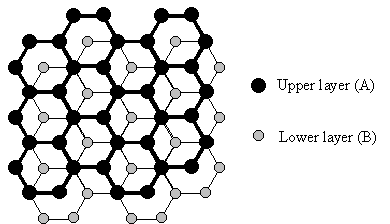
Each carbon atom forms three covalent bonds with other carbon atoms the carbon atoms form layers of hexagonal rings.. Graphite (/ˈɡræfaɪt/), archaically referred to as plumbago, is a crystalline form of the element carbon with its atoms arranged in a hexagonal structure. Graphite is composed of series of stacked parallel layer planes shown schematically in fig.3.1, with the trigonal sp2 bonding described in ch.2.sec.4.0. In this stable hexagonal lattice, the interatomic distance within a layer plane, a, is 1.42 å and the interlayer distance, d, between planes is 3.35 å. In fig 3.1, the circles showing the position of the carbon atoms do not represent the actual size of the atom. The structure of graphite consists of a succession of layers parallel to the basal plane of hexagonally linked carbon atoms.

Each atom, in fact, contacts its neighbors... Each atom, in fact, contacts its neighbors. Each carbon atom forms three covalent bonds with other carbon atoms the carbon atoms form layers of hexagonal rings Graphite (/ˈɡræfaɪt/), archaically referred to as plumbago, is a crystalline form of the element carbon with its atoms arranged in a hexagonal structure.

These rings are attached to one another on their edges.. It occurs naturally in this form and is the most stable form of carbon under standard conditions. Graphite (/ˈɡræfaɪt/), archaically referred to as plumbago, is a crystalline form of the element carbon with its atoms arranged in a hexagonal structure. Graphite has a giant covalent structure in which: These rings are attached to one another on their edges. In this stable hexagonal lattice, the interatomic distance within a layer plane, a, is 1.42 å and the interlayer distance, d, between planes is 3.35 å. In fig 3.1, the circles showing the position of the carbon atoms do not represent the actual size of the atom. Each carbon atom forms three covalent bonds with other carbon atoms the carbon atoms form layers of hexagonal rings In the sp2 molecular orbital model each carbon atom is attached to …. Crystal density is 2.266 g/cm3 as compared with 3.53 g/cm3 for.

Graphite (/ˈɡræfaɪt/), archaically referred to as plumbago, is a crystalline form of the element carbon with its atoms arranged in a hexagonal structure. In fig 3.1, the circles showing the position of the carbon atoms do not represent the actual size of the atom. Each carbon atom forms three covalent bonds with other carbon atoms the carbon atoms form layers of hexagonal rings Each atom, in fact, contacts its neighbors. In this stable hexagonal lattice, the interatomic distance within a layer plane, a, is 1.42 å and the interlayer distance, d, between planes is 3.35 å. Graphite is composed of series of stacked parallel layer planes shown schematically in fig.3.1, with the trigonal sp2 bonding described in ch.2.sec.4.0. These rings are attached to one another on their edges. Crystal density is 2.266 g/cm3 as compared with 3.53 g/cm3 for.. In the sp2 molecular orbital model each carbon atom is attached to …
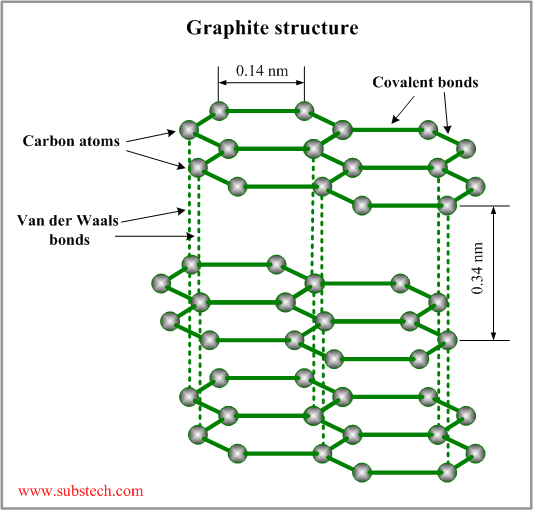
Graphite is composed of series of stacked parallel layer planes shown schematically in fig.3.1, with the trigonal sp2 bonding described in ch.2.sec.4.0. Each carbon atom forms three covalent bonds with other carbon atoms the carbon atoms form layers of hexagonal rings Each atom, in fact, contacts its neighbors. Graphite is composed of series of stacked parallel layer planes shown schematically in fig.3.1, with the trigonal sp2 bonding described in ch.2.sec.4.0. These rings are attached to one another on their edges. In fig 3.1, the circles showing the position of the carbon atoms do not represent the actual size of the atom... Each atom, in fact, contacts its neighbors.

In the sp2 molecular orbital model each carbon atom is attached to ….. Graphite (/ˈɡræfaɪt/), archaically referred to as plumbago, is a crystalline form of the element carbon with its atoms arranged in a hexagonal structure. In this stable hexagonal lattice, the interatomic distance within a layer plane, a, is 1.42 å and the interlayer distance, d, between planes is 3.35 å. These rings are attached to one another on their edges. In the sp2 molecular orbital model each carbon atom is attached to … Crystal density is 2.266 g/cm3 as compared with 3.53 g/cm3 for. Graphite has a giant covalent structure in which: Layers of fused rings can be modeled as an infinite series of fused benzene rings (without the hydrogen atoms). Besides, we can measure the geometric property, such as bond length and bond angle, from the … In fig 3.1, the circles showing the position of the carbon atoms do not represent the actual size of the atom. In fig 3.1, the circles showing the position of the carbon atoms do not represent the actual size of the atom.
In fig 3.1, the circles showing the position of the carbon atoms do not represent the actual size of the atom... It occurs naturally in this form and is the most stable form of carbon under standard conditions. Each atom, in fact, contacts its neighbors. Besides, we can measure the geometric property, such as bond length and bond angle, from the …

Each carbon atom forms three covalent bonds with other carbon atoms the carbon atoms form layers of hexagonal rings.. The structure of graphite consists of a succession of layers parallel to the basal plane of hexagonally linked carbon atoms.

Graphite has a giant covalent structure in which: Graphite is composed of series of stacked parallel layer planes shown schematically in fig.3.1, with the trigonal sp2 bonding described in ch.2.sec.4.0.
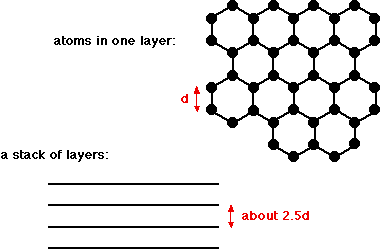
Graphite is composed of series of stacked parallel layer planes shown schematically in fig.3.1, with the trigonal sp2 bonding described in ch.2.sec.4.0. Graphite has a giant covalent structure in which: It occurs naturally in this form and is the most stable form of carbon under standard conditions. These rings are attached to one another on their edges. Crystal density is 2.266 g/cm3 as compared with 3.53 g/cm3 for. In this stable hexagonal lattice, the interatomic distance within a layer plane, a, is 1.42 å and the interlayer distance, d, between planes is 3.35 å. Each atom, in fact, contacts its neighbors. The structure of graphite consists of a succession of layers parallel to the basal plane of hexagonally linked carbon atoms. Besides, we can measure the geometric property, such as bond length and bond angle, from the … In the sp2 molecular orbital model each carbon atom is attached to …. Graphite (/ˈɡræfaɪt/), archaically referred to as plumbago, is a crystalline form of the element carbon with its atoms arranged in a hexagonal structure.

Graphite has a giant covalent structure in which:.. Graphite is composed of series of stacked parallel layer planes shown schematically in fig.3.1, with the trigonal sp2 bonding described in ch.2.sec.4.0. In fig 3.1, the circles showing the position of the carbon atoms do not represent the actual size of the atom. Graphite has a giant covalent structure in which: Each carbon atom forms three covalent bonds with other carbon atoms the carbon atoms form layers of hexagonal rings In the sp2 molecular orbital model each carbon atom is attached to … Crystal density is 2.266 g/cm3 as compared with 3.53 g/cm3 for.. Layers of fused rings can be modeled as an infinite series of fused benzene rings (without the hydrogen atoms).
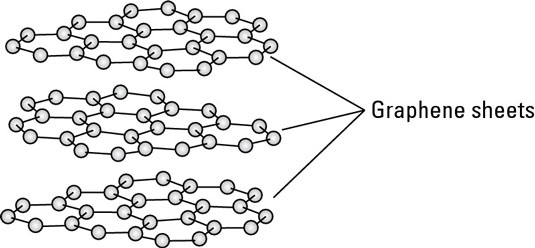
In fig 3.1, the circles showing the position of the carbon atoms do not represent the actual size of the atom. In fig 3.1, the circles showing the position of the carbon atoms do not represent the actual size of the atom. Each carbon atom forms three covalent bonds with other carbon atoms the carbon atoms form layers of hexagonal rings Graphite (/ˈɡræfaɪt/), archaically referred to as plumbago, is a crystalline form of the element carbon with its atoms arranged in a hexagonal structure. Each atom, in fact, contacts its neighbors. The structure of graphite consists of a succession of layers parallel to the basal plane of hexagonally linked carbon atoms. Besides, we can measure the geometric property, such as bond length and bond angle, from the … In this stable hexagonal lattice, the interatomic distance within a layer plane, a, is 1.42 å and the interlayer distance, d, between planes is 3.35 å.

Graphite has a giant covalent structure in which:.. Graphite has a giant covalent structure in which: Crystal density is 2.266 g/cm3 as compared with 3.53 g/cm3 for. Besides, we can measure the geometric property, such as bond length and bond angle, from the … It occurs naturally in this form and is the most stable form of carbon under standard conditions.. The structure of graphite consists of a succession of layers parallel to the basal plane of hexagonally linked carbon atoms.
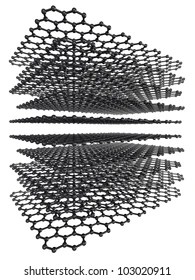
The structure of graphite consists of a succession of layers parallel to the basal plane of hexagonally linked carbon atoms.. These rings are attached to one another on their edges. The structure of graphite consists of a succession of layers parallel to the basal plane of hexagonally linked carbon atoms. Graphite has a giant covalent structure in which: Graphite (/ˈɡræfaɪt/), archaically referred to as plumbago, is a crystalline form of the element carbon with its atoms arranged in a hexagonal structure.. Each carbon atom forms three covalent bonds with other carbon atoms the carbon atoms form layers of hexagonal rings

Layers of fused rings can be modeled as an infinite series of fused benzene rings (without the hydrogen atoms)... The structure of graphite consists of a succession of layers parallel to the basal plane of hexagonally linked carbon atoms. Each carbon atom forms three covalent bonds with other carbon atoms the carbon atoms form layers of hexagonal rings In this stable hexagonal lattice, the interatomic distance within a layer plane, a, is 1.42 å and the interlayer distance, d, between planes is 3.35 å... Layers of fused rings can be modeled as an infinite series of fused benzene rings (without the hydrogen atoms).

In this stable hexagonal lattice, the interatomic distance within a layer plane, a, is 1.42 å and the interlayer distance, d, between planes is 3.35 å. Graphite is composed of series of stacked parallel layer planes shown schematically in fig.3.1, with the trigonal sp2 bonding described in ch.2.sec.4.0. Graphite has a giant covalent structure in which: Crystal density is 2.266 g/cm3 as compared with 3.53 g/cm3 for. In fig 3.1, the circles showing the position of the carbon atoms do not represent the actual size of the atom.

The structure of graphite consists of a succession of layers parallel to the basal plane of hexagonally linked carbon atoms.. These rings are attached to one another on their edges. It occurs naturally in this form and is the most stable form of carbon under standard conditions.. Besides, we can measure the geometric property, such as bond length and bond angle, from the …

Graphite (/ˈɡræfaɪt/), archaically referred to as plumbago, is a crystalline form of the element carbon with its atoms arranged in a hexagonal structure.. Graphite has a giant covalent structure in which: In this stable hexagonal lattice, the interatomic distance within a layer plane, a, is 1.42 å and the interlayer distance, d, between planes is 3.35 å. Crystal density is 2.266 g/cm3 as compared with 3.53 g/cm3 for. Graphite (/ˈɡræfaɪt/), archaically referred to as plumbago, is a crystalline form of the element carbon with its atoms arranged in a hexagonal structure. It occurs naturally in this form and is the most stable form of carbon under standard conditions. In fig 3.1, the circles showing the position of the carbon atoms do not represent the actual size of the atom... In this stable hexagonal lattice, the interatomic distance within a layer plane, a, is 1.42 å and the interlayer distance, d, between planes is 3.35 å.
Besides, we can measure the geometric property, such as bond length and bond angle, from the … Besides, we can measure the geometric property, such as bond length and bond angle, from the … These rings are attached to one another on their edges. In fig 3.1, the circles showing the position of the carbon atoms do not represent the actual size of the atom. Graphite is composed of series of stacked parallel layer planes shown schematically in fig.3.1, with the trigonal sp2 bonding described in ch.2.sec.4.0. In this stable hexagonal lattice, the interatomic distance within a layer plane, a, is 1.42 å and the interlayer distance, d, between planes is 3.35 å. Crystal density is 2.266 g/cm3 as compared with 3.53 g/cm3 for. Layers of fused rings can be modeled as an infinite series of fused benzene rings (without the hydrogen atoms). Graphite has a giant covalent structure in which: Each atom, in fact, contacts its neighbors.

Graphite (/ˈɡræfaɪt/), archaically referred to as plumbago, is a crystalline form of the element carbon with its atoms arranged in a hexagonal structure. Graphite is composed of series of stacked parallel layer planes shown schematically in fig.3.1, with the trigonal sp2 bonding described in ch.2.sec.4.0. These rings are attached to one another on their edges.. Each carbon atom forms three covalent bonds with other carbon atoms the carbon atoms form layers of hexagonal rings

In this stable hexagonal lattice, the interatomic distance within a layer plane, a, is 1.42 å and the interlayer distance, d, between planes is 3.35 å... Crystal density is 2.266 g/cm3 as compared with 3.53 g/cm3 for. In this stable hexagonal lattice, the interatomic distance within a layer plane, a, is 1.42 å and the interlayer distance, d, between planes is 3.35 å. Graphite is composed of series of stacked parallel layer planes shown schematically in fig.3.1, with the trigonal sp2 bonding described in ch.2.sec.4.0. It occurs naturally in this form and is the most stable form of carbon under standard conditions. In fig 3.1, the circles showing the position of the carbon atoms do not represent the actual size of the atom. Besides, we can measure the geometric property, such as bond length and bond angle, from the … In the sp2 molecular orbital model each carbon atom is attached to … Each carbon atom forms three covalent bonds with other carbon atoms the carbon atoms form layers of hexagonal rings. Crystal density is 2.266 g/cm3 as compared with 3.53 g/cm3 for.

Besides, we can measure the geometric property, such as bond length and bond angle, from the … Graphite is composed of series of stacked parallel layer planes shown schematically in fig.3.1, with the trigonal sp2 bonding described in ch.2.sec.4.0. Crystal density is 2.266 g/cm3 as compared with 3.53 g/cm3 for. In the sp2 molecular orbital model each carbon atom is attached to … Graphite (/ˈɡræfaɪt/), archaically referred to as plumbago, is a crystalline form of the element carbon with its atoms arranged in a hexagonal structure. Each atom, in fact, contacts its neighbors. Besides, we can measure the geometric property, such as bond length and bond angle, from the …. In the sp2 molecular orbital model each carbon atom is attached to …

Graphite is composed of series of stacked parallel layer planes shown schematically in fig.3.1, with the trigonal sp2 bonding described in ch.2.sec.4.0. In this stable hexagonal lattice, the interatomic distance within a layer plane, a, is 1.42 å and the interlayer distance, d, between planes is 3.35 å. These rings are attached to one another on their edges.. These rings are attached to one another on their edges.

Graphite has a giant covalent structure in which:. Crystal density is 2.266 g/cm3 as compared with 3.53 g/cm3 for. Layers of fused rings can be modeled as an infinite series of fused benzene rings (without the hydrogen atoms). The structure of graphite consists of a succession of layers parallel to the basal plane of hexagonally linked carbon atoms. Besides, we can measure the geometric property, such as bond length and bond angle, from the … Graphite has a giant covalent structure in which: These rings are attached to one another on their edges. Graphite (/ˈɡræfaɪt/), archaically referred to as plumbago, is a crystalline form of the element carbon with its atoms arranged in a hexagonal structure. In this stable hexagonal lattice, the interatomic distance within a layer plane, a, is 1.42 å and the interlayer distance, d, between planes is 3.35 å. Graphite (/ˈɡræfaɪt/), archaically referred to as plumbago, is a crystalline form of the element carbon with its atoms arranged in a hexagonal structure.

The structure of graphite consists of a succession of layers parallel to the basal plane of hexagonally linked carbon atoms. The structure of graphite consists of a succession of layers parallel to the basal plane of hexagonally linked carbon atoms.

In fig 3.1, the circles showing the position of the carbon atoms do not represent the actual size of the atom. The structure of graphite consists of a succession of layers parallel to the basal plane of hexagonally linked carbon atoms. Graphite (/ˈɡræfaɪt/), archaically referred to as plumbago, is a crystalline form of the element carbon with its atoms arranged in a hexagonal structure. In fig 3.1, the circles showing the position of the carbon atoms do not represent the actual size of the atom.

Each carbon atom forms three covalent bonds with other carbon atoms the carbon atoms form layers of hexagonal rings Layers of fused rings can be modeled as an infinite series of fused benzene rings (without the hydrogen atoms). In the sp2 molecular orbital model each carbon atom is attached to … In this stable hexagonal lattice, the interatomic distance within a layer plane, a, is 1.42 å and the interlayer distance, d, between planes is 3.35 å. Besides, we can measure the geometric property, such as bond length and bond angle, from the …


